Saturday, 23 November 2019

Joined By A Footbridge - Pataua and Whananaki

Recently published in Motorhomes Caravans and Destinations Magazine
Pataua and Whananaki are tricky to get to, but once you discover their delights, it’s all water under the bridge, says Heather Whelan

The communities of Pataua and Whananaki on the Northland coast are each divided in half by rivers, both halves connected only by picturesque footbridges. There is no road that joins these two settlements, clustered around estuaries on the coast north of Whangarei. Each is discovered individually after a tortuous drive through rugged bush and rural paddocks, but they are well worth it.
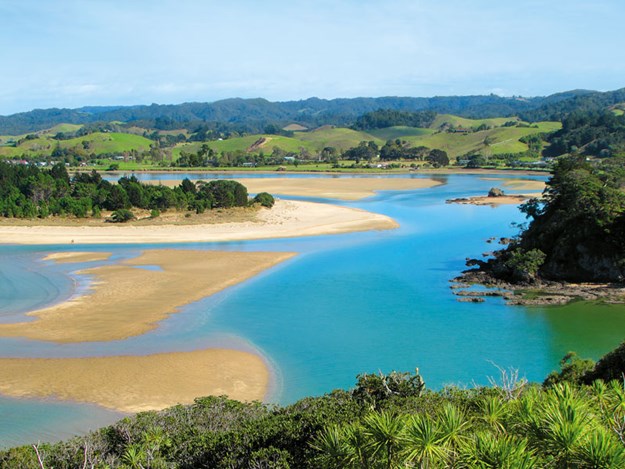
Whelan_15-Whananaki-Estuary-from-the-Headland-Track.jpg

A honey of a place

Whelan_3-The-Honey-House-Cafe.jpg
The Honey House Cafe
The road to Pataua North wiggled east from Whangarei, skirting the banks of the Horahora River before turning south. A couple of kilometres before reaching Pataua we saw brightly coloured flags at the roadside and a paddock full of cars.
People were buzzing around a red barn like the bees around the hives across the road. We discovered that Tahi – home to honey producers, a cafe and a nature sanctuary – was having its annual open day.
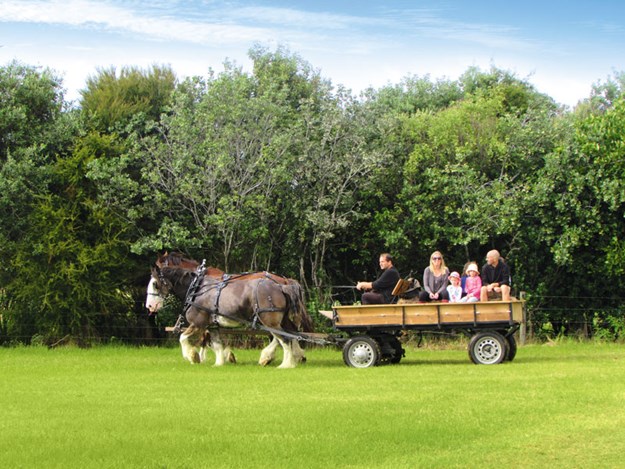
Whelan_4-Clydesdale-rides-at-the-open-day.jpg
Clydesdale rides at the open day
We were keen to see what was happening, and before long had signed up for the ‘bee experience’ and ‘honey house’ visit. We strolled over to the cafe for a coffee before our first tour was due. 
Sustained by some very chocolate-y brownies, we joined a group of people donning beekeepers’ suits and, looking something like a crowd of astronauts, we gathered around the hives and learned all about bees and honey.
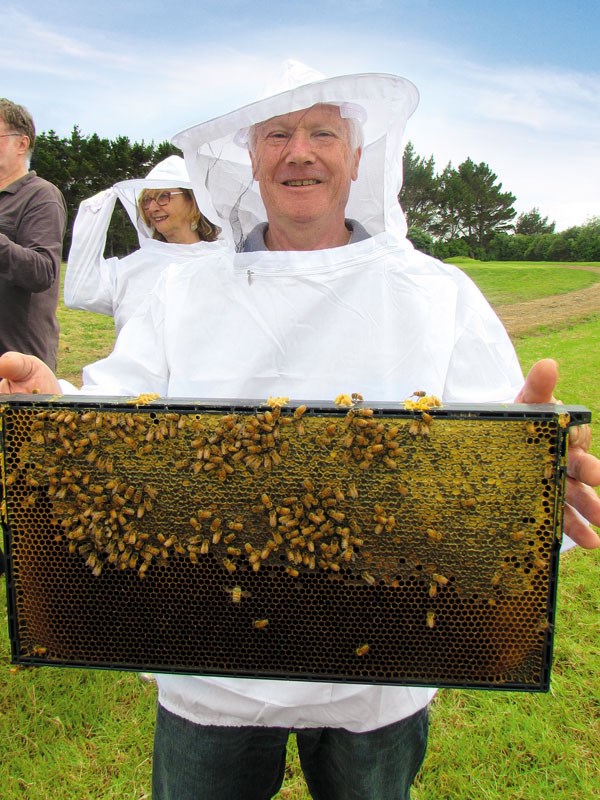
Whelan_2-Learning-about-honey-at-Tahi.jpg
Learning about honey at Tahi
Later we were shown around the processing area and discovered how the honey gets from comb to jar. Tahi’s name comes from the mountain and pa, Ohua Tahi, which means ‘first place of plenty’. The honey they sell is a testament to the pristine location of the hives.
Before leaving Tahi we explored one of the four walks in the 315-hectare sanctuary. The boardwalk track took us beside a lake and through wetlands. We had tackled the longer forest walk previously (Tahi is open to the public on Sundays over summer) and looked forward to doing the estuary walk and beach walk another time.

Picturesque Pataua
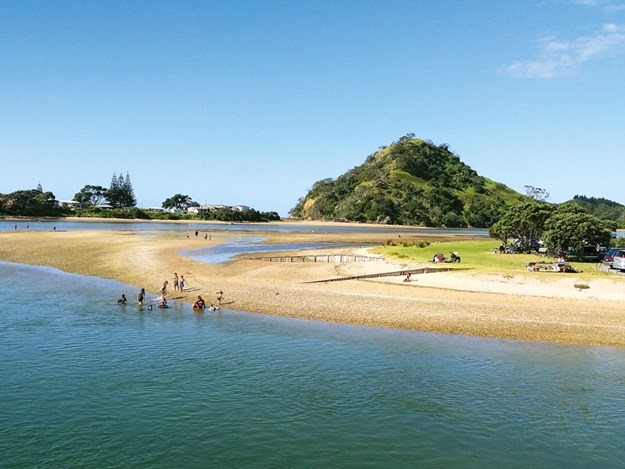
Whelan_8-Pataua-South.jpg
Pataua South
Leaving Tahi, we soon arrived at Pataua North. There’s not a lot of parking space during busy times but there is usually room to freedom camp at the little reserve close to where the estuary meets the sea.
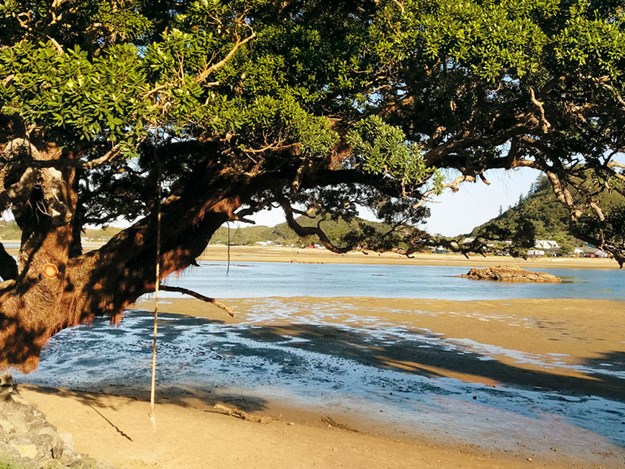
Whelan_7-Pataua-estuary.jpg
Pataua estuary
There is also a small car park near the footbridge that links Pataua North with Pataua South. Clustered around the river mouth and beachfront, much of the settlement is made up of holiday homes and baches. 
Pataua is a typical Kiwi holiday spot. Pohutukawa trees line the sandy shores of the estuary, brilliant red with blossom in summer. The calm water is popular with kayakers and swimmers, while the footbridge is often crowded with those waiting their turn to fling themselves down into the water.
Surfers love the long, sandy  Parauwanui Beach, while families flock to the shallow estuary and more protected beach at Pataua South, known to locals as Frogtown. Lively in summer, Pataua is peaceful out of season.

Longest footbridge
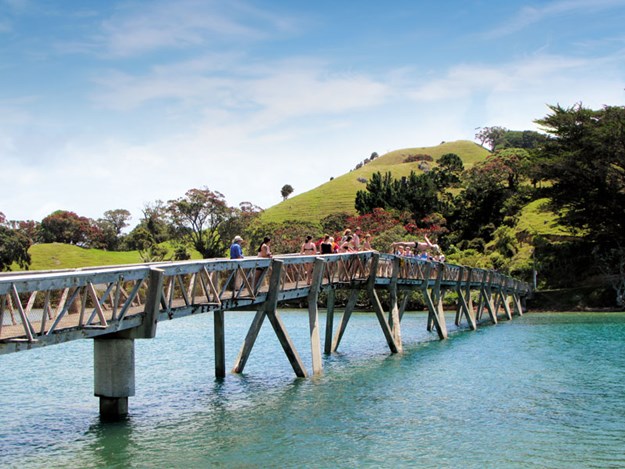
Whelan_5-Pataua-footbridge.jpg
Further north, Whananaki boasts an even longer footbridge than Pataua’s. With a length of 395 metres, it’s the longest footbridge in the southern hemisphere, and was built so children living on the south side of the Whananaki Inlet could attend the school in Whananaki North.
Before it was constructed the teacher had to row the students back and forth. There is still a school at Whananaki and the village also boasts a store, hall and holiday park. There is a long history of Maori settlement in the area.
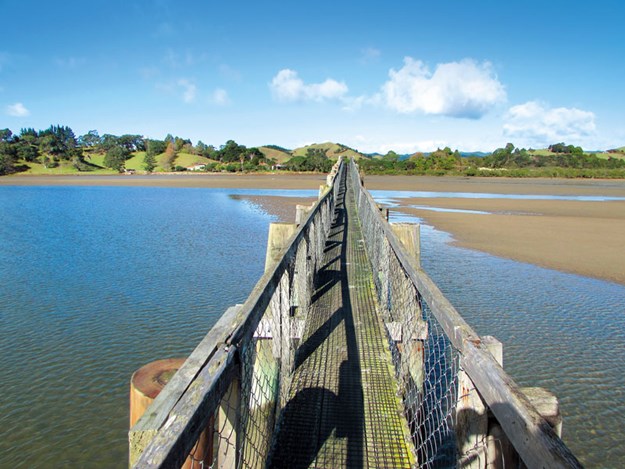
Whelan_20-Whananaki-footbridge.jpg
Whananaki footbridge
Whananaki, which means kicking, is said to have been named by the captain of the Mataatua canoe, who spent a sleepless night on account of the mosquitoes here. Insect screens make life easier nowadays – motorhomers can stay at the holiday park, one of the two campgrounds, or freedom camp at the reserve on Whananaki North Road.
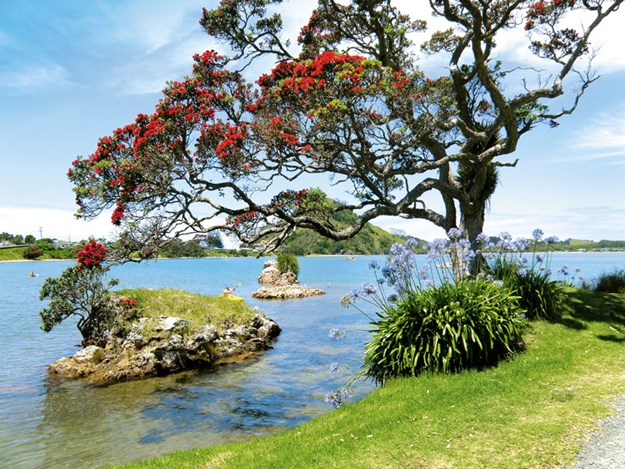
Whelan_9-The-estuary-at-Pataua-North.jpg
The estuary at Pataua North
Like Pataua, Whananaki has a sheltered estuary, great for swimming, fishing and gathering pipis. Kayakers can explore the mangroves, a haven for birdlife. There are popular beaches tucked into headlands along the coast – Moureeses and Otamure Bay are accessible from the road while Tauwhara Bay is a short walk through flax, cabbage trees and manuka.
Whelan_14-On-the-Headland-Track-at-Whananaki-North.jpg
On the Headland Track at Whananaki North
A longer, two-hour return walk took us along the Motutara Track to the headland, where we had gorgeous 360 degree views of the coast, mountains and forests of the interior.

A shipwreck memorial
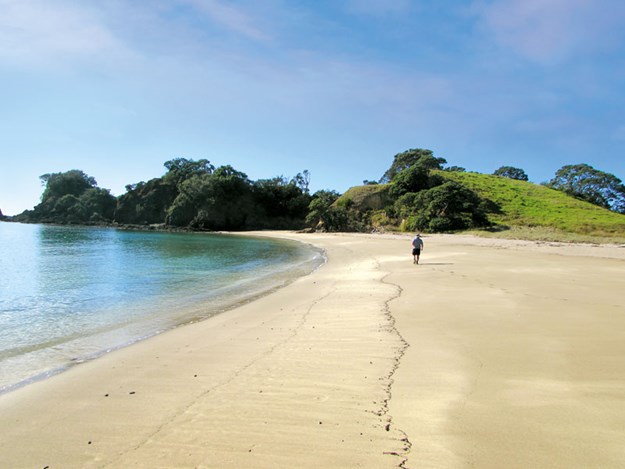
Whelan_11-Beautiful-beaches-at-Whananaki-North.jpg
Beautiful beaches at Whananaki North
Across the footbridge at Whananaki South we found we were even further off the beaten track. A long, sandy beach led us to rocky Pitokuku Point, and from here we walked part of the Whananaki Walkway.
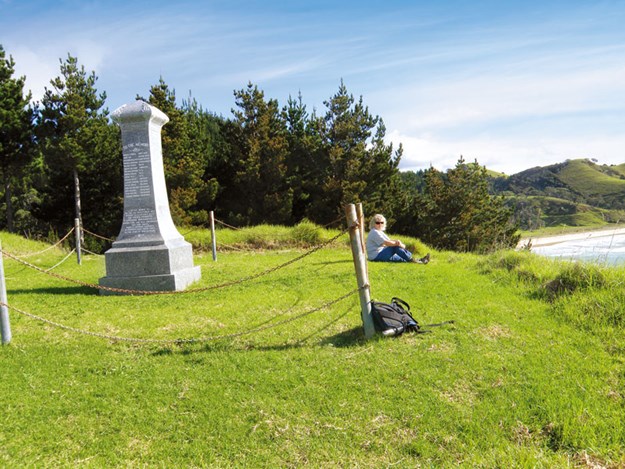
Whelan_19-The-Capitaine-Bougainville-Monument.jpg
The Capitaine Bougainville Monument
The whole track goes south to Sandy Bay and takes three hours one way, but we only completed the first section this time, to the Capitaine Bougainville Monument. A side track took us through pine forest to the monument marking the place where the Capitaine Bougainville, a freighter carrying meat and dairy products, caught fire and sank in 1975.
Sixteen of the crew and passengers aboard perished, as lifeboats capsized in stormy seas. On a peaceful, sunny day, with fabulous views, it was hard to imagine the deadly conditions that led to the tragedy.
Back in Whananaki North we enjoyed a coffee at the cafe outside the store. We might have had to travel long and winding roads to reach both Whananaki and Pataua, but we were glad we did. And discovering the remarkable footbridges that linked the two halves of the settlements was the icing on the cake.

FURTHER INFORMATION

  • Details about the cafe and walks at Tahi can be found at tahinz.com.
  • Access to Pataua North is via Whareora and Pataua North Roads, while to get to Pataua South, take Whangarei Heads Road, then turn onto Pataua South Road. Both routes are around 30km from Whangarei.
  • Details of the Pataua South campground can be found at treasureislandnz.co.nz.
  • Freedom camping at Pataua North is for self-contained vehicles only; maximum stay three nights
  • Whananaki North is about 35km north of Whangarei. Turn off SH1 onto Whananaki North Road. To get to Whananaki South turn off SH1 at Hikurangi and follow Marua and Whananaki South Roads.
  • Information about camping at Whananaki can be found at whananakiholiday.co.nz; Motutara Farm’s website is campingholiday.co.nz; for the DOC campsite at Otamure Bay visit doc.govt.nz.
  • Details of the Whananaki Walkway can be found on the Whangarei District Council’s website: wdc.govt.nz. If walking the track one-way, it is good to be picked up at Sandy Bay, though the drive back to Whananaki is 32km.

South Island's Iconic Sheep and Cattle Stations

MCD writer Heather Whelan explores some of the South Island’s iconic sheep and cattle stations

The South Island is famous for its towering mountain ranges, sweeping plains, picturesque lakes and majestic fjords. Many beauty spots are justifiably well-known and, amazing though they are to visit, are often crowded with visitors.
Alt TEXT HERE
Molesworth is New Zealand’s largest farm
When hubby Malcolm first suggested visiting some high country stations, I was a little anxious – after all, a glance at the map showed nothing but empty spaces. Some online research reassured me it was possible, in fact desirable, to drive through these remote stations and see for ourselves the little-known, wide expanses of wilderness that make up these gigantic farms.


MIGHTY MOLESWORTH

Alt TEXT HERE
The historic Acheron Accommodation House is getting a facelift
Molesworth Station is open to the public over summer, and the 207km journey from Hanmer Springs to Blenheim through the station makes a great alternative route for campervans and vehicles under seven metres.
There are camping spots at the Acheron Accommodation House and Molesworth Cob Cottage, so there are options to break the trip and explore some of the walks along the route, or just park and admire the views.
The main road through Molesworth is the Acheron Road – other roads are 4WD only. Because our bus was too long, we left it parked at the NZMCA Park at Hanmer Springs and explored by car as a day trip. From Hanmer Springs the Clarence Valley Road leads north.
Cut into the side of a vertigo-inducing, steep hillside, this goes over Jacks Pass and into the station. At over 180,000 hectares, Molesworth is New Zealand’s largest farm and is administered by the Department of Conservation, with Landcorp Farming responsible for the station’s 10,000 head of beef cattle.
Driving through the station, it is hard to believe that 70 years ago the area was abandoned, the land untenable because of the destruction caused by thousands of sheep and millions of rabbits. Luckily, rabbit control, re-sowing and conservation practices have turned Molesworth around – now visitors can be awed by the beauty of the landscape. 

A welcome sight

The Acheron Accommodation House, built in 1862 as an overnight stop for stockmen and travellers, is the oldest building at Molesworth. Of cob construction, it has a roof of beech rafters, thatched with tussock.
I had been looking forward to seeing the historic buildings on the station and was sad to see that they had been damaged by the 2016 earthquake. However, despite red tape, the Accommodation House still looks picturesque and was no doubt a welcome sight for early travellers.
(Renovation of the house has recently begun, with contractors planning to retain as much as is possible of the original fabric of the building. Hopefully this summer’s visitors will be able to safely admire the house, inside and out.)
Alt TEXT HERE
The Lower Acheron Suspension Bridge
The Accommodation House marks the start of 59km of road leading to the Molesworth Cob Cottage at the northern boundary of the station. This section of road can be driven in two hours but we took much longer as we lingered – to read information panels, at shelters, at suspension bridges and at every spot that called to be photographed.
Alt TEXT HERE
Roadside shelters  provide information panels
Our first stops were by the river, where wooden suspension bridges span clear, fast-flowing water. On this quiet day, with only birds for company, it’s hard to imagine that once 15,000 sheep were driven over the river where the Lower Acheron Suspension Bridge now stands.
Further on we admired Pig Trough Suspension Bridge, named for the wild pigs living in a nearby gully. Both these bridges are relatively new, replacing earlier bridges washed away by floods.

Murder at Molesworth

Near the confluence of the Severn and Acheron Rivers is an area still called Red Gate, though the gate is long gone. A signboard tells the sad tale of Ivanhoe Augarde. The young man wrote a letter to his sweetheart and entrusted its delivery to a worker called German Charlie. Unfortunately, Charlie read the letter to other men as he travelled north.
When Ivanhoe discovered that he’d been the subject of ridicule he set off in pursuit of Charlie and killed him. He then returned to the Red Gate, where he turned the gun on himself. The tale is memorialised in the name of nearby Mount Augarde.


LAKES, VALLEYS AND MOUNTAINS

Alt TEXT HERE
Lake Wakatipu
Our next station visit took us to Walter Peak, on the shores of Lake Wakatipu. Walter Peak is primarily a sheep station, founded in 1860 and still going strong. It runs around 18,000 sheep and 800 beef cows.
Small compared to Molesworth, the station still covers more than 25,000 hectares. There is no through route – the drive is around 90km each way, starting form a small turn-off on the Te Anau-Mossburn Highway, SH9.
With our usual number of photo stops, explorations and a relaxing break at Walter Peak Station, it took six hours for the round-trip. Mavora Lakes was our first stop. Situated in a mountainous landscape, surrounded by tussock grassland and beech forests, it is a magical place and was used by Sir Peter Jackson when filming The Lord of the Rings.
Alt TEXT HERE
There are photo-worthy spots aplenty in Molesworth 
The forests of South Mavora Lake became ‘Fangorn Forest’, while the Mararoa River became the ‘Silverlode’. Enthusiastic trampers can trek the 50km Mavora-Greenstone walkway starting here, but we just wandered around the lakeside and adjacent bush, imagining hobbits and elves behind every tree.
There is a DOC camping ground at the lakes, accessible to motorhomes and caravans, and the area is popular with those who love the outdoors. Many activities that are not normally allowed in national parks are permitted here, including 4WD driving (on tracks), hunting, water sports, horse trekking, trout fishing and mountain biking.
Alt TEXT HERE
A glimpse of Lake Wakatipu at Walter Peak
It’s a great base for the drive to Lake Wakatipu. The road from Mavora Lakes to Walter Peak leads straight towards the horizon, with the high Eyre and Thomson mountain ranges on each side.
There are a couple of fords to negotiate and some narrow bridges that have fords beside them – so heavy vehicles can use the route. Suddenly, and unexpectedly, the valley was revealed to be a plateau. A lower valley appeared and the road dipped steeply into it.
Alt TEXT HERE
The road to Walter Peak Station
Then it was on as before until we reached the shores of Lake Wakatipu, where there were views up the lake towards Glenorchy and across towards Queenstown. The road then skirted past Mt Nicholas Station, finally arriving at the lakeside at Walter Peak Station.

Picturesque Peak

Alt TEXT HERE
Walter Peak is rich in colonial history
As a contrast to the empty, open drive, this felt like an oasis. There were old, white-painted buildings, including the Colonel’s Homestead – rebuilt on a grander scale after a fire in 1977–surrounded by English-style cottage gardens and lawns. There were jetties and a boat was pulled up on the beach.
There was also a hotel with a restaurant and a bar, where we gratefully ordered long cold drinks. On the drive we only passed one vehicle, a couple of cyclists and a posse of horse-trekkers, but the station buildings were busy – a group of tourists had come across earlier by boat, the Earnslaw, from Queenstown.
Alt TEXT HERE
Shearing at Mesopotamia Station
As we sat enjoying the view they made their way to the shearing shed for an agricultural show and we had the place to ourselves. In the distance the TSS Earnslaw could be seen making her way back from Queenstown, across the blue waters of the lake.
Alt TEXT HERE
Coal-fired passenger ship the TSS Earnslaw
Built in 1912, the picturesque Earnslaw is the last remaining coal-fired passenger vessel in the southern hemisphere. When the boat arrived to pick up the tourists for their return trip to Queenstown we decided it was time we left Walter Peak Station too, as it was now late afternoon and we had the return journey ahead.

The road to ‘Nowhere’

Alt TEXT HERE
Mesopotamia is one of the country’s oldest high country stations
A later road trip took us to the curiously named Mesopotamia Station. We were exploring the Peel Forest area, near Geraldine, and realised that the station was only about an hour further on.
Mesopotamia means ‘the land between two rivers’, and originally referred to the area between the Tigris and Euphrates, in present-day Syria and Iraq. Mesopotamia Station was named by Samuel Butler, the English writer who established it in 1860, and it’s one of the country’s oldest high country stations.
Because the area is so isolated, Butler called the satirical novel he wrote there Erewhon – ‘nowhere’ spelled backwards. Our drive took us alongside the braided Rangitata River, and through the valley between the Rangitata and Forest Creek rivers.
At 6000 hectares, Mesopotamia is a comparatively small station but was equally as scenic as Molesworth and Walter Peak. The station has been owned by the Prouting family since 1945 and runs 11,000 sheep, 3000 deer and 500 cattle.
We pass several herds of deer, the stags proudly sporting massive antlers, but it’s sheep that are the main attraction. We saw sheep wandering in the road, sheep in paddocks and sheep being penned and shorn in a woolshed.
Mesopotamia wool is still baled with the stencilled candlestick logo used since the 1860s. We stopped at the end of the road to take photos at the station’s outbuildings. Mesopotamia certainly is in the middle of nowhere, a wide valley with a backdrop of snowy mountains.
As the crow flies, Fox Glacier is probably as close as Geraldine; just the impenetrable Southern Alps between us! But that’s the lure of these remote stations on less-travelled roads: New Zealand at its wildest and most picturesque.

Further Information

  • Information about Molesworth Station, including a downloadable brochure, can be found at doc.govt.nz.
  • The Acheron Road through Molesworth Station isn’t suitable for caravans or buses over seven metres long. Small campervans will have no problem. We left our bus parked and used the car for our station road trips.
  • Access to Molesworth Station is seasonal. This year the road will be open from 7am to 7pm from Labour Weekend to Easter Monday (or the second Sunday of April, whichever is the later date).
  • Access by road to Walter Peak Station is from SH94. Details of the boat trip can be found at queenstownnz.co.nz.
  • It is 50km from Peel Forest to Mesopotamia Station, along unsealed Rangitata Gorge Road. The station’s website is mesopotamia.co.nz.

Whangarei's Hidden Delights

An article published in Motorhomes caravans and Destinations Magazine
Tucked away in Whangarei’s Western Hills are two hidden gems: old quarries given a new lease of life and linked by a pretty bush walk. Heather Whelan goes exploring.

Garden oasis

A fluttering flag at the roadside marked our turn from Western Hills Drive onto Russell Rd. A few twists and turns, then we saw a parking area (an overflow from the main car park and suitable for large motorhomes).
A short distance along a bush-lined driveway was Quarry Gardens, a subtropical oasis in what was once a stone quarry. Beside the main car park a modern building nestled into the foliage, its design echoing the industrial heritage of the site – many remnants of its stone-quarrying past are integrated into the gardens.
This building housed the Visitor’s Information Centre and Quail Cafe. Over a bridge and inside the building we were tempted to stop for a coffee but decided to explore the gardens first.
Signage outside the building explained some of the history of the gardens. We learned that in the 1940s the quarry was an industrial site and, after its closure in the ‘70s, the land became little more than an overgrown rubbish dump.
Twenty years later, a far-sighted local called Laughton King had the dream of establishing gardens there. The council, who owned the land, came on board and a group of volunteers began the task of clearing the site and establishing a garden.
Now the 24 hectare site is home to a variety of native and exotic plants and is bounded by native bush. As we gazed round we realised the gardens were landscaped within a natural amphitheatre: the hillsides rose steeply – with steps leading up in places to tracks that encircled the gardens.
Alt TEXT HERE
The old stone quarry has been transformed
We wandered first through the ‘five senses garden’ where we were encouraged to smell, touch, listen and look at the mainly subtropical plants – but not to taste! We were asked to take photos instead.
Winding paths led us past a bromeliad area, studded with orchids, and on to a camellia collection. Many of the 115 varieties donated to the gardens, are unique to the Quarry Gardens, in that they are not to be found in other public gardens anywhere in the world. This must be a Mecca for camellia buffs.

Exotic fauna

We couldn’t help taking photo after photo of the strange and exotic plants. There was a tree with huge thorns growing from its bark. It was called the silk floss tree, which sounds much more benign than the sharp prickles would lead you to expect.
A native of tropical South American forests, it has a cotton-like fibre in its seed pods. Nearby an Australian Burrawang, a cycad dating back to dinosaur days, thrust palm-like leaves skywards, and a chili plant from the Andes came with a warning – its peppers are extremely hot.

Locals to the rescue

At the rear of the gardens a waterfall dropped 40 metres into a man-made, but natural-looking, lake. We took a track to the top of this waterfall and looked down at the gardens spread beneath us. From this vantage point we could fully appreciate the amount of work that has 
gone into establishing and maintaining the gardens. Whangarei Council passed responsibility for the gardens to the Whangarei Quarry Gardens Trust back in 2000 and volunteers meet weekly to tend the gardens and establish new areas.
The local community is justifiably proud of the gardens. This was demonstrated after an arsonist set fires on the hillside around the gardens in 2005. in just one day,10,000 native trees were planted by by 250 volunteers to help revegetate the slopes.
As we walked back down to the cafe for a welcome snack we noticed school children had left brightly painted, concrete-filled gumboots beside plantings of kauri trees that line one of the pathways. They had environmental messages written on them, illustrating that you are never too young to treasure your surroundings. 

Funky shapes

Alt TEXT HERE
At the Sculpture Northland exhibition, Quarry Gardens
Near the cafe we stopped to admire a sculpture. Created by Chris Booth, the towering wood and stone ‘goddess’ named Varder V, has been designed to slowly decompose and alter over time.
On another occasion we visited the gardens to admire the varied works by local artists and sculptors as part of the Sculpture Northland exhibition. Tucked in among the plantings were everything from dragons to a feline ‘terracatta’ army.

A space for artists

The Quarry Arts Centre, further along the Western Hills, has been a hub for the art and craft community since the 1980s. We drove past a funky mosaic guardian sculpture at the entrance and parked outside the Quarry Cafe.
Unlike the popular Quail Cafe at the Quarry Gardens, this little cafe had a much more hippy vibe. With seating inside for four, while six can sit outside, it must be Whangarei’s tiniest cafe. 
The Arts Centre itself was the brainchild of the late potter Yvonne Rust, who founded the trust. A gallery was first opened in 1984. After a rebuild in 2011, it is now known as the Yvonne Rust Gallery and has regularly changing exhibitions.
Alt TEXT HERE
We admired the quirky and curious creations in the Grate Plate display. Opposite the gallery we discovered the Quarry Craft Co-op Shop, where we browsed handmade treasures in glass, leather, pottery, greenstone and textiles.
I couldn’t resist some glass earrings, knowing they were unique. Dotted around the quarry were slightly ramshackle – almost organic – buildings: homes and workshops for the artisans who thrive at the Arts Centre.
Quirky sculptures, examples of the artists’ work, could be seen outside the buildings and in gardens. Seeing a sign advertising an upcoming market, we made a note to check it out.
This was an event not to be missed. Live jazz was issuing from the veranda outside the gallery and the area was crammed with stalls selling ceramics, glassware, garden art – there was something for everyone and the Arts Centre was the perfect backdrop.

A bush walk

Alt TEXT HERE
The start of the walk through the Coronation Reserve
Behind one stall we spotted the start of a walkway and decided to investigate further. This was an entrance into the Coronation Reserve, a stand of native bush in the Western Hills, named to commemorate the coronation of King George V, and with tracks that link both quarries.
We couldn’t resist exploring, so set out from the Quarry Gardens one sunny morning a while later, and followed a track up and into the hills. A turn led into the Coronation Reserve where we walked along the Frank Holman Track, marveling that we were so close to the city yet deep in bush.
Before dropping down into the Quarry Arts Centre we took a side track for a look at a pa site. From here we could get peeks down into Whangarei. Then, after another look around the Quarry Arts Centre, we retraced our steps and rewarded ourselves with lunch at the Quarry Gardens.

Further information

  • The Quarry Gardens are at 37A Russell Road, Whangarei. The gardens are open 7 days, 9am - 5pm. Quail Cafe is open Wednesday - Sunday, 9am - 3pm.
  • The Quarry Arts Centre is at 21 Selwyn Avenue, Whangarei. The gallery is open Monday to Saturday, 9.30am - 4.30pm. The cafe is open Monday - Friday, 10am-2pm.
  • Information about the tracks in the Coronation Scenic Reserve can be found at wdc.govt.nz. You can also find a downloadable and printable map on this website.

Exploring Auckland

This article featured in Motorhomes caravans & Destinations Magazine 
Lush parks, birdlife, nature walks and award-winning bike trails… it’s Auckland, but not as you know it, says Heather Whelan 

Auckland is New Zealand’s largest city and all too often we just want to drive through it, hoping there are no hold-ups on the motorway. However, there is always plenty to see and do in the City of Sails – and it isn’t all connected with boating.
In-love-with-Auckland-city_1.jpg

Lately, we have made a point of stopping in Auckland to experience some of the city’s unique attractions. Downtown Auckland is easy to walk around. Last time we visited we wandered up Queen St to check out the Auckland Art Gallery.
From here we walked to the War Memorial Museum, through the Domain – though I admit we took the train back from Newmarket to Britomart, as it would have been quite a hike to walk both ways. Auckland is well served by public transport and, being gold card holders, we were able to use the buses, trains and ferries for free.

lava caves and ghosts

Alt TEXT HERE
The historic Ferry Terminal building
The one ferry ride we did have to pay for was out to Rangitoto Island, as this was not a commuter trip. Nevertheless, it was well worth the price of the ticket. Rangitoto translates as ‘Bloody Sky’, named by Maori who saw the volcano that formed the island erupt about 600 years ago, and it is the dominating landmark of the Hauraki Gulf.
Alt TEXT HERE
Rangitoto was created by a volcanic eruption 600 years ago
From the downtown Ferry Terminal, our boat trip took around 25 minutes, passing all manner of craft – from yachts to a Maori voyaging canoe. Disembarking at Rangitoto Wharf was like entering another world. The big city – out of sight here – seemed far away.
Alt TEXT HERE
A glimpse of the city from the track to the summit
Black scoria rock littered the ground; a track of smaller pieces led off towards the summit. Rangitoto’s symmetrical cone towered 260 metres above us, its flanks clothed by the largest pohutukawa forest in the world. 
Before setting off to walk to Rangitoto’s summit I wanted to check out some of the baches scattered near the wharf. Mostly built in the 1920s and 30s, no-one lives in them now as the island is a scenic reserve, administered by the Department of Conservation.
Alt TEXT HERE
In the distance, an old bach, a relic from the days when Rangitoto was inhabited
A few of these old homes remain, preserved to show visitors a snapshot of long-ago island life. As I peered in the windows of the ghost settlement I found it hard to imagine the island was once home to several hundred people.
There was even a prison here at one time – it was the convicts who formed the tracks that visitors use today. It took around an hour to reach Rangitoto’s high point, passing through the pohutukawa forest and bush that contained over 200 species of trees, flowers and fern.
This is amazing, given that there are no streams on the island and the plants rely on rainfall for moisture. DOC’s eradication programmes have been so successful that introduced creatures – such as possums and wallabies, as well as the usual deer, goats, stoats, rats, cats and mice – have all gone.
Rangitoto became pest free in 2011. There were seats and viewing platforms at the island’s summit, with great views of the island-studded Hauraki Gulf, and of Auckland in the distance.
Alt TEXT HERE
Caves formed by molten lava
We could see the city’s other volcanic cones punctuating the cityscape, and right across to the Waitakere Ranges and the Manukau Harbour. After lunch on Rangitoto’s summit, we took a track that looped round to some lava caves.
These tubes were left behind when the molten lava of Rangitoto’s eruption hardened on the outside but still-liquid lava flowed through inside. The caves would have been fun to explore, but we didn’t have torches with us, so left that to some excited children and continued back to the main track and down to the wharf for our ferry.

cycling the rainbow

Alt TEXT HERE
The rainbow section on the cycle trail
Another day a group of us grabbed our bikes and investigated part of the burgeoning network of urban cycle trails that link the suburbs and city centre. Auckland Transport produce a series of handy maps that show shared paths, protected cycle lanes, quiet routes and on-road cycleways.
We left from Avondale, taking the Waterview Path through a series of reserves to the Great North Road. A section of the cycle track was painted in rainbow stripes here, an unexpected sight that took our mind off the fact that we were going uphill.
In-love-with-Auckland-city_7.jpg
Although we were soon nearing the city centre the route remained quiet, skirting first a golf course and then the fringes of villa-filled Kingsland streets. Finally we found ourselves on the famous pink Lightpath, Te Ara I Whiti, an award-winning structure that took us above busy streets and down to the Viaduct Harbour.
Alt TEXT HERE
At the end of the Lightpath
After that exercise we felt justified in having lunch in one of the restaurants that line the watersides. Then it was back onto our bikes and we cycled along past the beautiful, yellow-hued Edwardian ferry building and into Britomart, where we loaded our bikes and ourselves onto a train back to Avondale.
There are several places for motorhomers to stay in Auckland city. NZMCA members can stay at Tui Glen in Henderson (right on another cycle trail) and there are motor camps in Avondale and Remuera, as well as the option of staying at clubs and Park Over Properties.

a bird lovers’ dream

Alt TEXT HERE
Looking out at the Manukau Harbour from Ambury
One place we have stopped on a few occasions is Ambury – one of Auckland Regional Council’s parks – on the Manukau Harbour, with a campground area where self-contained vehicles can stay.
Alt TEXT HERE
Self-contained vehicles can stay at Ambury
We enjoyed the walk along the harbour foreshore from the campground, an area popular with birdwatchers as it is a significant shorebird habitat. The big skies and expansive harbour views were stunning, and the walk was interesting even for those of us with limited ornithological knowledge as there were sign boards explaining local history along the way.
Another track of historical interest was the Lost Gardens Walk, where there are remnants of the stone mounds Maori used in their gardens. Further on, this links to a walking and cycling path leading to the Otuataua Stonefields and Mangere Mountain, one of Auckland’s largest volcanic cones.
Ambury is a farm park, with a variety of animals to admire. Along the 1km walk around the farm area visitors can see sheep, cows, goats, pigs, chickens, rabbits and peacocks. In spring visitors can check out the lambs and even feed them – great for children to experience.

Flora and Sculpture

In-love-with-Auckland-city_13.jpg
A little further afield is the NZMCA Park at Ardmore Airport. Because it is close to Papakura Station we have taken the train into central Auckland and haven’t had to worry about parking.
Another advantage of staying at Ardmore is the proximity to Auckland Botanic Gardens. For years we had whizzed past the Botanic Gardens sign as we drove along the motorway, and talked about calling in there some day, but – after visiting the gardens the first time we stayed at Ardmore – it is now a place we visit frequently.
Alt TEXT HERE
 Bird lady sculpture near the visitor centre
Whatever the season, it is fantastic to wander through some of the 64 hectares of land, admiring the huge variety of plants. The gardens are arranged thematically so you can check out everything from the Edible Garden to the Gondwana Arboretum.
There are rose gardens, rock gardens, palm gardens, native forest, lakes, lawns and much more! We love coming upon sculpture. Sometimes it is tucked away within a garden area, at other times there are displays on the grassy area between the lakes and Huakaiwaka, the visitor centre.
Alt TEXT HERE
Colourful sculpture at the Botanic Gardens
Huakaiwaka is a sculptural building itself, featuring a stone wall, water feature and tree-like columns that support a butterfly roof above the atrium. There’s also a really good cafe here, a great place to enjoy lunch while overlooking swathes of the gardens.
There’s such a lot to see and do in Auckland that we have only made a start on our bucket list. We won’t make the mistake of passing through our biggest city without stopping to explore again!
Alt TEXT HERE
The Auckland Botanic Gardens is home to many intriguing sculptures – from the surreal to the colourful and playful

Further Information

  • The NZMCA parks are at Tui Glen Reserve, Claude Brookes Drive, Henderson, and Ardmore Airfield, Harvard Lane, Ardmore.
  • Information about Ambury Regional Park, and about staying in a motorhome at Auckland’s other regional parks, can be found on the council’s website: aucklandcouncil.govt.nz.
  • There is a wealth of ideas and information about what to see and do in Auckland at: aucklandnz.com/visit.
  • Auckland Art Gallery Toi o Tamaki is at the corner of Kitchener and Wellesley St. More information on their website, aucklandartgallery.com.
  • The Auckland War Memorial Museum is in the Auckland Domain, Parnell. For hours, exhibitions and other information see aucklandmuseum.com.
  • Timetables and other details about the ferry to Rangitoto Island can be found at: fullers.co.nz. There are maps of the island on board the ferries. The walk to the summit is around one hour from Rangitoto Wharf and there are other tracks of varying lengths on the island.
  • The Auckland Botanic Gardens are at 102, Hill Rd, Manurewa. For full details go to aucklandbotanicgardens.co.nz.

Friday, 28 June 2019

A magical History Tour

This is my latest article in Wilderness Magazine (July 2019 issue)....
A magical history tour
Wenderholm Regional Park has a fascinating history. The first people to enjoy the area were the Polynesian ancestors of Māori. Later, descendants of the Tainui and Moekaraka canoes explored the Puhoi and Waiwera Rivers, fished and built gardens. Little remains from those days except shell middens and place names – Wenderholm’s sandy spit is still called Te Akeake and the headland is Maungatauhoro. Wenderholm’s current name was bestowed on the area by a friend of Robert Graham, who bought the land in the 1840s, and means winter home in Swedish.


The Maungatauhoro Te Hikoi Track, starts near Couldrey House, an attractive, two-storey colonial house. Originally built by Robert Graham in 1857, it was added to by subsequent owners before becoming almost derelict. The Couldrey family restored the house during the 1960s and continued living there after selling Wenderholm to the Auckland Regional Authority in 1965. When they left in 1973, Couldrey House reverted to the council.

We left the quaint cottage garden and entered native bush beside a carved pouwhenua. The track leads fairly steeply up towards the cliffs of the headland and gives stunning views of the Te Akeake sand spit, the Puhoi River and the hills beyond. To the north are the headlands of Mahurangi Harbour and out to sea islands dot the ocean towards Kawau.


The sand spit is covered with gnarled pohutukawa, splashes of red visible from the track. These trees were planted over a century ago and form the largest grove of planted pohutukawa in the world.

The native bush that covers the headland is a typical mix of kahikatea, manuka, nikau, rimu and tree fern and we were lured into it along the Couldrey House Track by large numbers of kererū and tui flying around the treetops. We were hoping to see a North Island robin, re-introduced to the park in 1999, but didn’t spot any.

After about 15 minutes, there’s an open area where the Couldrey House Track joins the Puhoi Track, which is an alternative way back to the Maungatauhoro Te Hikoi Track. This is another good lookout place with more great views – we could see past the Whangaparāoa Peninsula to Rangitoto Island.
Wanting to complete the headland track, we retraced our steps and then continued around to the southern side of Maungatauhoro. The track leads down to a sheltered little beach at Kokoru Bay, which looks across the river to Waiwera. Māori originally named this place Waiwerawera, very hot water, and it has been a thermal resort since the mid-1800s. Unfortunately, both the hot pools and the adjacent water-bottling facility have been closed and their future is uncertain.


Photo: Heather Whelan
The final part of the loop track runs close beside the estuary and past a turn-off, which leads to the road beside the Waiwera River Bridge. Then the track curves northward and runs parallel to Schischka Road to the car park near Couldrey House.